In a seller's market, an offer subject to the sale of your own home rarely gets accepted. Right now it does. That is not the good news it looks like, and it is why our answer to the oldest question in upgrading has changed.
Every bank and broker page on this question gives the same answer: it depends. They are right that it depends. They leave out what it depends on, which is the direction prices are moving between the day you sign and the day your own sale settles. In October 2026, in Brisbane and Adelaide, that direction is down, and it has been for six months. So this page gives an answer. Sell first. And it says what would change that.
| Path | How it works | What it does to your offer | When prices are falling |
|---|---|---|---|
| Sell first, then buy | Your sale settles, you rent or stay with family, then you buy with cash in hand | Clean. No sale condition, finance already sized to a known number | Runs with the market. You sell at today's price and buy at a later, lower one |
| Buy first with bridging finance | A lender advances the purchase against both properties, interest-only, until your sale settles | Clean. The strongest offer of the three | Runs against the market. Two loans at current rates, for longer, while the sale price moves away from you |
| Buy subject to sale | Your purchase is conditional on selling your own home by a stated date | Weakest. The vendor carries your risk, and most contracts let them keep marketing | Runs against the market twice. Purchase locked at today's price, sale lands at a later one |
Here is the sequence, using our own published numbers.
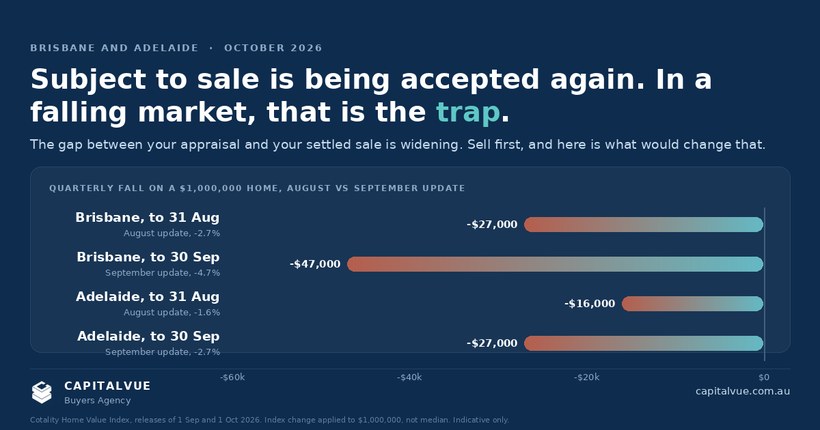
Our August update had Brisbane down 2.7% over the quarter and Adelaide down 1.6%. Say you had your home appraised in the first week of September, when those were the latest figures, and signed subject to sale that week. Your purchase price was locked that day. Your own sale would settle 60 to 90 days later.
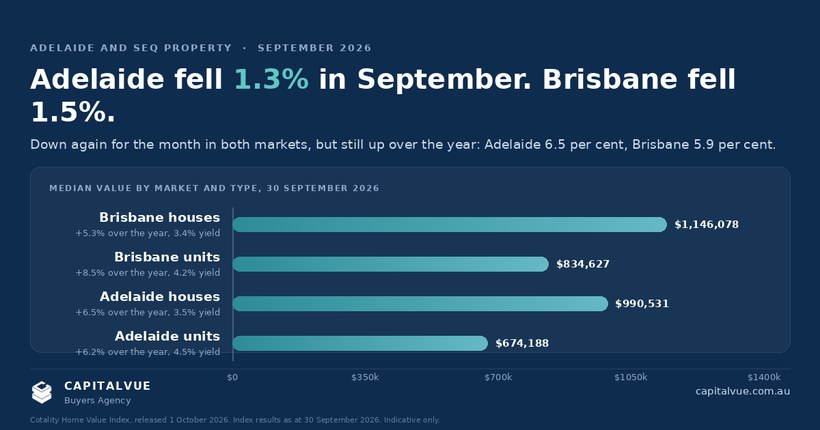
Our September update, released a month after you signed, had Brisbane down a further 1.5% in the month and 4.7% over the quarter. Adelaide was down 1.3% and 2.7%. On a $1,000,000 home, the September appraisal was $15,000 wrong in Brisbane and $13,000 wrong in Adelaide within a month, and the quarterly figures say the pace was increasing rather than steady. Against a June appraisal, the quarter to September took $47,000 off a Brisbane home and $27,000 off an Adelaide one.
Those figures are the Cotality index applied to a stated appraisal. We have not used the change in the median value, which fell further over the same period, because medians move with what happens to sell in a given month and the index does not.
That is the gap. The appraisal is last week's number. The settled sale is next quarter's. The purchase price sits locked in between, and the longer your own home takes to sell, the wider the gap gets. Capital city homes are currently taking a median of 39 days to sell against 23 a year ago.
Now the part that makes it a trap rather than a risk. Vendors accept subject-to-sale offers when they have fewer offers to choose from. That is exactly the condition that produces the gap. The clause is available for the same reason it is dangerous.
And it has a second edge. In Queensland, most subject-to-sale conditions give the vendor the right to keep marketing, and if a better offer arrives, to serve you a notice, commonly 48 to 72 hours, to either waive your condition and go unconditional or walk away. If your own sale has not settled, you cannot safely waive, so you lose the property. If you waive anyway, you are bound to settle whether or not your own home sells, which is how a buyer ends up owning two properties in a falling market with no plan for either. South Australian contracts work through special conditions in the same way, and the vendor's reluctance to carry your risk is the same.
Bridging finance solves the offer problem and creates a carrying one. The lender advances the purchase against both properties, you pay interest-only on the peak debt, usually for a set period of up to 12 months, and the end debt is whatever remains once your sale settles.
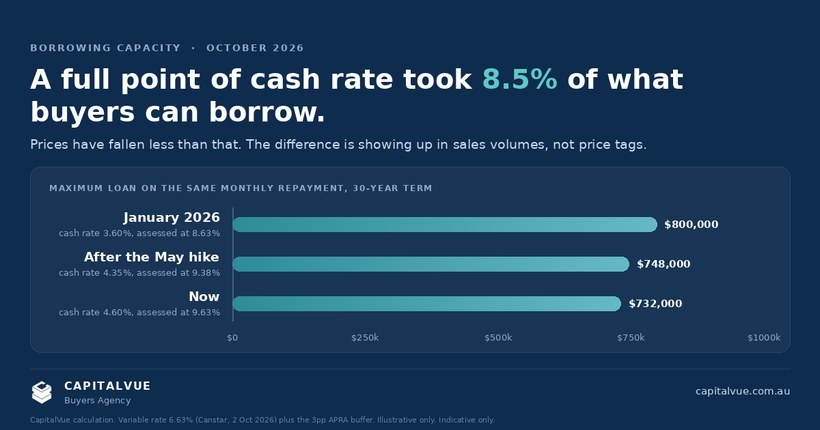
Three things are moving the wrong way at once. The rate: the cash rate target is 4.60% after the 29 September increase, the highest since 2011, and bridging rates can sit above standard variable rates. A full point of cash rate this year has already taken about 8.5% off what the same income can borrow, as we set out in the borrowing capacity piece, and a bridging facility is assessed against that reduced figure. The duration: 39 days to sell, not 23, so the interest-only period runs longer. The exit: the sale price that is meant to clear the bridge is the one falling. Lender guidance itself names the shortfall as the risk, where the home sells for less than the figure the loan was sized on.
Bridging is still the strongest offer of the three. It is also the one where the market works hardest against you.
Sell first is the only path where the sequence runs with the direction of prices. You sell at today's number, which on the current data is higher than next quarter's. You then buy at next quarter's number, which is lower. The gap that punishes the other two paths works for you.
Its usual cost is buying in a hurry, or renting for months while you look. That cost is smaller than it has been in years. Advertised stock is 23.1% higher than a year ago, homes are taking more than two extra weeks to sell, auction clearance rates are below half, and you are negotiating with vendors who have been on the market for a while and have fewer offers in hand. The pressure to buy the first adequate thing is lower than it would be in any other recent market.
And you know your real number. Not an appraisal, not an estimate, not what the agent thinks it should go for. The settled figure. Every decision on the purchase side gets made against that, and your offer carries no condition the vendor needs to discount.
Our answer is tied to the data, and the data has a date on it. Three signals would reverse it. Any two together and sell first becomes sell low and buy high.
Cotality's own expectation in its October release is a gradual drift lower in values rather than a sharp fall. That is their forecast, not ours, and forecasts get revised. We will update this page when the signals move, with the date of the change on it.
Settlement periods are negotiated, and the two settlements rarely land on the same day by accident. Sell first means you are between homes for the gap, which is a rental lease or a stay with family, plus two moves. Bridging means you own both for the gap and pay for both. Subject to sale means both settlements have to be sequenced so your sale clears before your purchase, which is the part most buyers underestimate.
Your conveyancer sequences this. Settlement dates, the order of funds, what happens if one side slips. Get them involved before the contract is signed, not after, because the dates in the contract are the ones that bind.
Illustrative figures only, on stated assumptions, for a three-month gap.
| Path | Carrying cost, 3 months | Basis |
|---|---|---|
| Sell first and rent | About $9,800 in Brisbane, $8,400 in Adelaide | 13 weeks at the SQM combined asking rent, $755 and $643 a week, August 2026 |
| Bridging | About $16,600 on $1,000,000 of peak debt | Interest-only at the 6.63% average variable rate, Canstar 2 October 2026. Bridging rates can be higher, so treat this as a floor |
| Subject to sale | Nil to carry | The cost is the gap between appraisal and settled sale, which the worked example above puts at $13,000 to $15,000 a month on $1,000,000 |
The rent figure is the only one of the three that stays fixed once the lease is signed. The other two move with the market, and the market is moving against them.
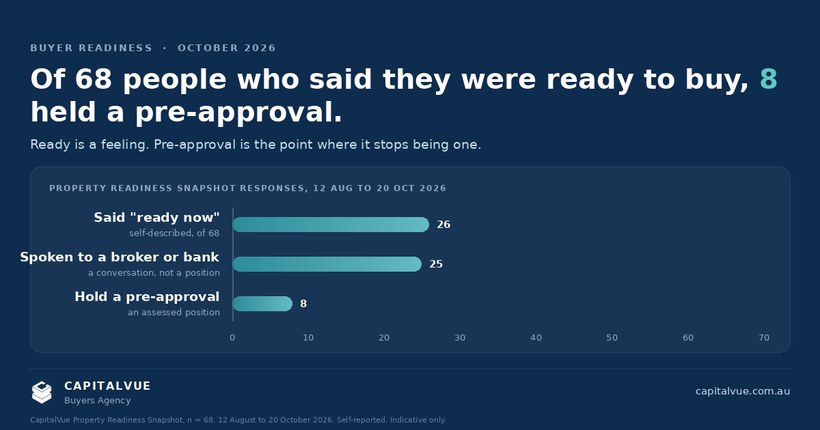
Of 68 people who completed our Property Readiness Snapshot between 12 August and 20 October, 28 were buying their next home rather than their first. Seven of those described themselves as cash buyers, which in an upgrade almost always means selling to buy. We have just added a question on whether people plan to sell first, and when it has a month of answers the figure will go here, with its date.
A mortgage broker on bridging, before anything else. Whether you qualify, at what rate, for how long, and what the lender will size the loan against. If you are selling first, the same conversation produces the assessed pre-approval your purchase offer will need, and we have written about what that is and is not. CapitalVue is not a mortgage broker and this is not credit advice. If you do not have a broker, reply to any email from us and we will introduce you to ours.
A conveyancer on sequencing, before you sign. The settlement dates, the subject-to-sale wording if you go that way despite the above, and what happens if one side slips.
Then the purchase. Once your sale has settled and the number is real, the search is a different exercise. If you want it run against the sales evidence rather than the guide, with the terms and the negotiation handled, that is what our Evaluate and Negotiate service does. If you are earlier than that, the Property Readiness Snapshot will tell you which of finance, brief or timing to sort first.
General information only, not financial product advice, credit assistance, legal advice, or a recommendation to buy or sell any particular property. CapitalVue is not a licensed credit provider or mortgage broker. The recommendation on this page is conditional on the direction of dwelling values as published by Cotality, which is a forecast and may prove incorrect; the conditions that would change it are set out above and the page will be updated with a dated note if they do. Figures are indicative and current as at October 2026. Sources: Cotality (formerly CoreLogic) Home Value Index, releases of 1 September and 1 October 2026, for the quarterly and monthly changes, days on market and advertised stock; Reserve Bank of Australia Monetary Policy Decision, 29 September 2026, cash rate target 4.60%; Canstar average variable owner-occupier rate 6.63%, 2 October 2026; SQM Research weekly rents, August 2026; Westpac and Melbourne Institute Consumer Sentiment Bulletin, 6 October 2026; bridging mechanics drawn from published lender guidance including NAB, accessed 21 October 2026; subject-to-sale mechanics from Empire Legal, Queensland, as at 13 October 2026, and the Legal Services Commission of South Australia Law Handbook; CapitalVue Property Readiness Snapshot responses, n = 68. Carrying costs are illustrations on stated assumptions, not quotes. Past performance is not a reliable indicator of future performance. Property values can fall. Consider your own circumstances and obtain independent financial, credit, legal and tax advice before making a property decision. CapitalVue is a licensed buyers agency operating in South East Queensland and Adelaide, licensed QLD 4769773 and SA 335016.
Tell us where you are at and we will tell you what we would look at next. You will hang up with a plan, not more questions.