Every page that ranks for this question was written by someone who wants to lend you money. This one was written by someone who has to tell you, before a search starts, whether you are actually ready.
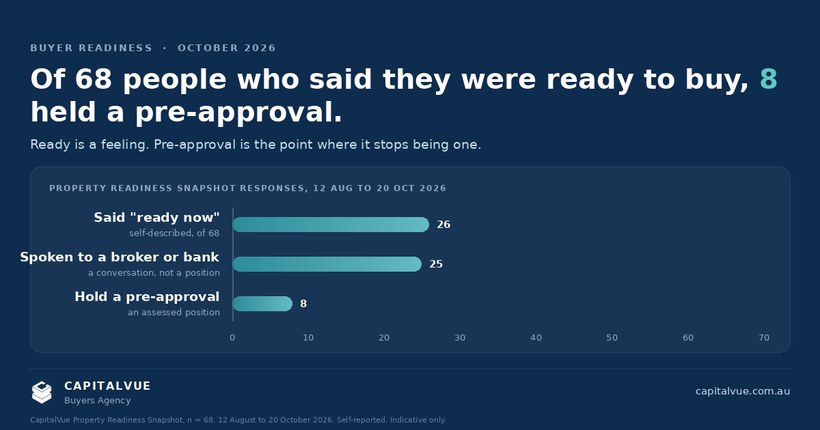
Between 12 August and 20 October 2026, 68 people completed our Property Readiness Snapshot. Twenty-six of them said they were ready to buy now. Eight of the 68 held a pre-approval.
Those two numbers are the whole article. Ready is a feeling. Pre-approval is the point where it stops being one.
Pre-approval, conditional approval and approval in principle are the same thing under three names. A lender has looked at your income, your expenses, your debts and your deposit, and has said that on that information it would be prepared to lend you up to a stated amount.
Three words in that sentence carry the weight: on that information. The lender has not seen a property. It has not valued one. It has not confirmed that your circumstances on the day you sign a contract match the ones you described on the day you applied. Pre-approval is a statement about you. Final approval is a statement about you and a specific property together, and it only comes once the valuation and the lender's own checks on that property are done.
That is why a pre-approval is conditional, not binding. A property the lender will not accept, a valuation that comes in under the contract price, or a change in your position between application and contract can all take it away.
This is the part the lender pages mention in passing and buyers almost never ask about.
Some pre-approvals are system-generated. You enter your figures, an automated assessment runs, and a letter comes back. Nothing has been manually verified. No credit assessor has read a payslip. Lender guidance describes these as less reliable and less comprehensive than the alternative, which is a fully assessed pre-approval, where a person at the lender has gone through your documents and tested the numbers.
A system-generated pre-approval is closer to a quote. A fully assessed one is a position. They can look identical on paper, and the difference only becomes visible at the moment you least want it to, which is after you have signed.
If you are not sure which one you hold, ask your broker or lender one question: was this assessed by a credit assessor, or generated by the system? The answer decides how much weight the letter can carry.
"I've spoken to a broker" is not a position. Of the 68 people in our sample, 25 had spoken to a broker or a bank. Eight held pre-approval. A conversation is the first step toward a position. It is not one.
A borrowing calculator is not a position either, including ours. Our Buying Power Calculator runs a serviceability estimate on the figures you enter, using an average rate and general assumptions about living expenses. It is useful for knowing whether a price range is plausible before you waste a Saturday. It is not an assessment of your file, it has not seen your statements, and no lender is bound by it. The number it gives you is the start of a conversation with a broker, not a substitute for one.
Pre-approval is also not a budget. Our services page puts it as a lender's appetite, not a budget, and that distinction matters just as much once you have the letter in hand. The amount a lender is prepared to advance and the amount you can comfortably hold through a rate rise, a renovation and a change of job are different numbers. Pre-approval tells you the first. Only you can work out the second.
The range quoted across lender and broker guidance is three to six months, and individual lender certificates commonly run 90 days from issue. Treat the date on the letter as the number that counts.
What resets it before that date:
One more thing the lender pages mention quietly. Each pre-approval application is recorded on your credit file as an enquiry. Several in a short period can lower your score, which then affects the next assessment. Applying to three lenders in a fortnight to see who offers the most is not a free exercise.
Eight of 68. Nine of the 68 were buying with cash, and a cash buyer has no need of a pre-approval, so the honest denominator is 59. Eight of those 59 held one. Of the 26 who described themselves as ready now, most did not hold the one document that would let them act on it.
The gap is not carelessness. It is sequencing. People start looking at listings first, because that is the enjoyable part, and finance second, because that is the paperwork. Then the right property appears before the paperwork is done, and the sequence that felt sensible on a Sunday becomes the reason the offer cannot be made on Tuesday.
What it costs at the pointy end is leverage. In the current market, Cotality has capital city homes taking a median of 39 days to sell against 23 a year ago, which means sellers are choosing between fewer offers and weighing each one more carefully. An offer with finance already assessed is a different proposition from an offer with a finance clause and a hope. The buyer with the pre-approval can shorten the finance condition, or drop it. The buyer without one cannot, and the vendor's agent knows exactly which is which.
The order matters more than the speed.
If you want to know where you stand against that sequence, the Property Readiness Snapshot takes a few minutes and tells you which of finance, brief or timing is the thing holding you up.
Not here. CapitalVue is not a mortgage broker and does not provide credit advice. We do not arrange loans, we do not recommend lenders, and nothing on this page is advice about whether you should borrow or how much.
Where we fit is the step before and the step after. Before, a search does not start until you can pay for what we buy. That means an assessed pre-approval, or proof of funds if you are buying with cash. You can engage us before that point, and the finance step is often where the first conversation begins, but the search itself waits for it, because a search run ahead of the finance puts you in front of properties you cannot act on, and time is the one thing a buyer in this market cannot get back. How we work is on our services page. After, once the position exists, we run the search inside it.
If you do not have a broker and would like an introduction to one, reply to any email from us and we will make it. It carries no obligation.
General information only, not financial product advice, credit assistance, or a recommendation to borrow or to buy any particular property. CapitalVue is not a licensed credit provider or mortgage broker. Figures are indicative and current as at October 2026. Sources: CapitalVue Property Readiness Snapshot responses, 12 August to 20 October 2026, n = 68; pre-approval duration and the system-generated versus fully assessed distinction drawn from published lender and broker guidance including NAB (conditional approval certificate valid for 90 days) and Aussie Home Loans (typically three to six months), both accessed 21 October 2026; Cotality Home Value Index, released 1 October 2026, for days on market. Pre-approval terms, durations and conditions vary by lender and are subject to change. Past performance is not a reliable indicator of future performance. Property values can fall. Consider your own circumstances and obtain independent financial, credit, legal and tax advice before making a property or borrowing decision. CapitalVue is a licensed buyers agency operating in South East Queensland and Adelaide, licensed QLD 4769773 and SA 335016.
Tell us where you are at and we will tell you what we would look at next. You will hang up with a plan, not more questions.