In a seller's market, losing means being outbid. In this market, it almost never does. If you missed the last one, the cause is probably on your side of the contract, and that is better news than it sounds, because it is the side you control.
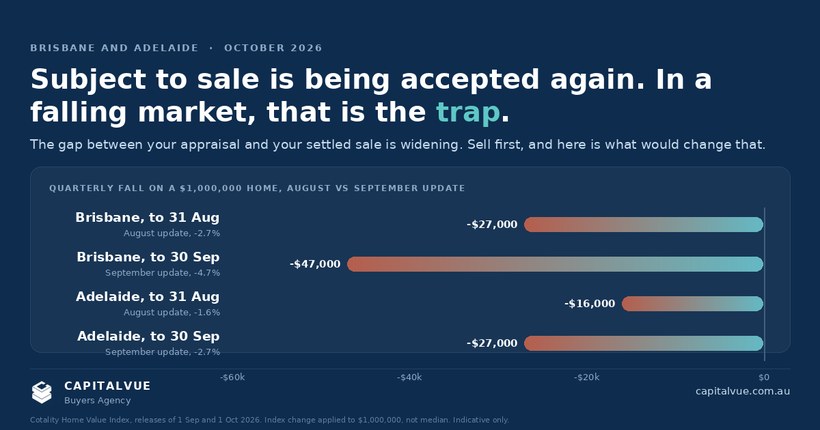
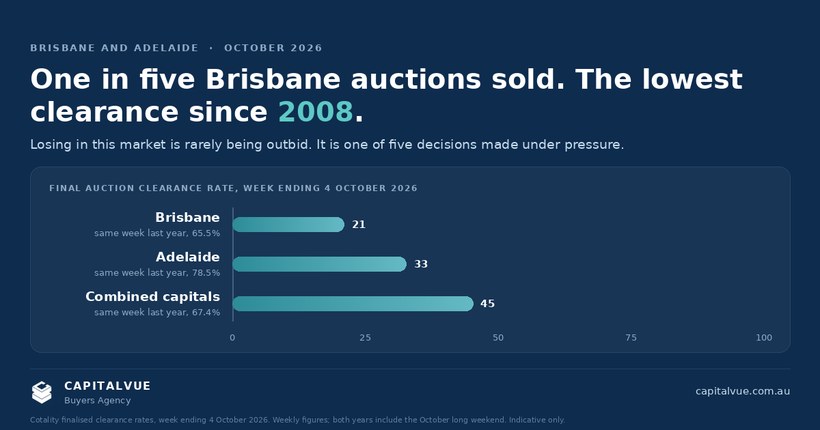
Here is the shape of the market you lost in. Capital city homes are taking a median of 39 days to sell, against 23 a year ago. Advertised stock is up 23.1% on a year earlier. The combined capital city auction clearance rate was 45.4% in the week to 4 October, 22 percentage points below the same week last year. Brisbane cleared 21.2%, its lowest since November 2008. Adelaide cleared 32.9%, against 78.5% a year earlier.
Those are not the numbers of a market where buyers get beaten to the line. They are the numbers of a market where most properties do not sell on the day, most offers are the only offer, and the buyer who misses out has usually done it to themselves.
When we sit down with someone who has lost a property, the story they tell is about price. Someone paid more. The agent wanted more. They could not stretch.
When we go back through the file, price is the cause in a minority of cases. The rest fall into five patterns, and they repeat.
Every one of those is a decision, not a bank balance. Which means every one of them changes next time.
The fastest way to lose a negotiation is to open it without knowing what the thing is worth. An offer made on the strength of the listing photos, the guide and a single walk-through is an offer made on the vendor's information, and the vendor's agent knows it.
Evidence means settled comparable sales, same suburb, same type, recent, and the overlays, the body corporate records and the building report read before the number goes in, not after. Our due diligence checklist sets out what that looks like in Queensland and South Australia. A buyer who has done it can hold a number under pressure. A buyer who has not will move on the first counter, and the agent will have seen that coming.
The price guide is a marketing decision. It is set to generate enquiry, and in a falling market it is often set above where the vendor would actually sell, because the vendor's expectations were formed in a market that ended in March. Why there is no price on the listing covers what each form of the guide is for.
The buyer who anchors to it loses in two directions. Offer at the guide and you may be paying above the evidence. Offer a token amount under it and you have told the agent you are not serious, and the agent stops returning calls. Neither is a negotiation. The number that holds is the one the comparable sales support, stated once, with the reasoning, and left there.
Two offers, same price. One is subject to finance with a 21-day clause, subject to a building and pest inspection, and asks for a 90-day settlement. The other has finance already assessed, the inspection done, and offers a 30-day settlement. The vendor's agent does not need to think about it.
Conditions are where a buyer loses to a lower offer, and it happens more in this market, not less. A vendor who has been on the market for 39 days and has one offer in hand will still take a cleaner one at a lower price, because the risk of the first one falling over and starting again is worth more to them than the difference.
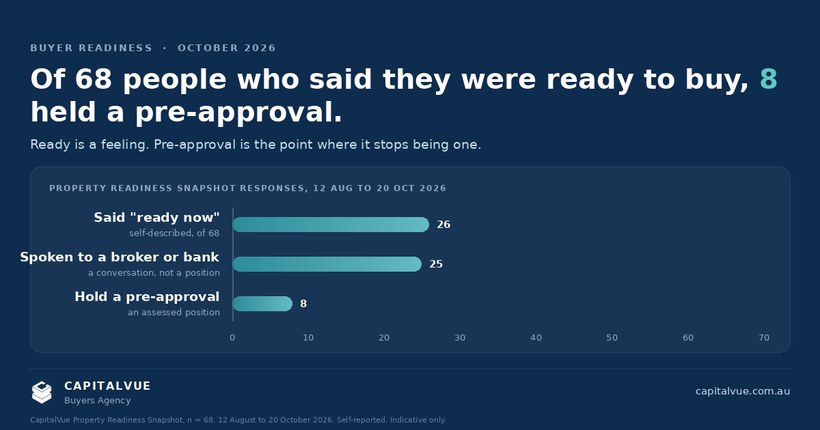
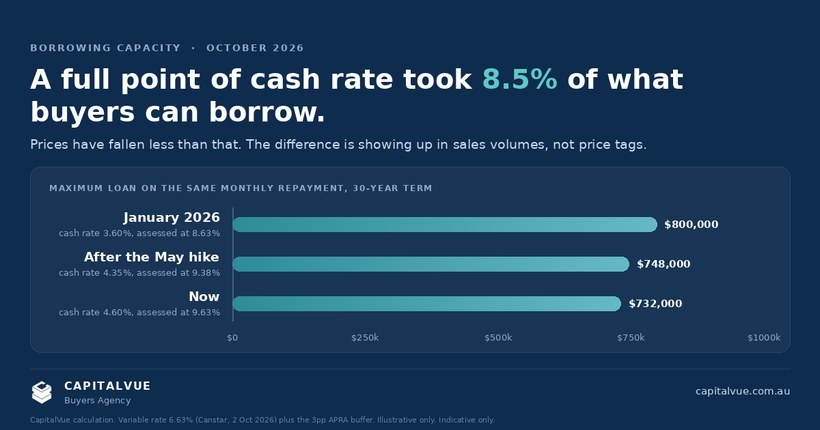
The finance clause is the one that decides most of these, and it is the one most buyers could have removed before the search began. An assessed pre-approval lets you shorten the finance condition or drop it. We set out what that means in pre-approval, explained without a loan to sell. A buyer without one cannot offer clean terms, whatever the price, and in a market where vendors are choosing on certainty rather than on price, that is the difference.
Settlement length matters more than buyers think. In a falling market a vendor wants the money sooner, not later. Offering a short settlement costs you nothing if your finance is in place and it is often worth more to the vendor than a few thousand dollars.
A year ago the risk at auction was being outbid. With Brisbane clearing one in five and Adelaide one in three, the risk has moved. Most auctions now end with the property passed in, and the real negotiation happens in the ten minutes afterwards, between the vendor's agent and whoever is standing closest.
That is where buyers lose now. Either they bid against nobody, because the auctioneer's opening bid was a vendor bid and they did not know it, or they let the property pass in and then negotiate the post-auction price on the spot, without evidence, without a walk-away number, in front of an agent whose job is to close that afternoon. There is no cooling-off period on an auction purchase in either Queensland or South Australia. The decision is final the moment the hammer falls, or the moment you sign in the agent's car afterwards.
The buyer who walks in with a ceiling set from the sales evidence, knows what a vendor bid looks like, and has decided before the day whether they will negotiate after a pass-in or walk, does not lose at auction. They either buy inside their number or leave. Both are results.
Sometimes the loss is the one you did not make an offer on. The property ticked every box, the evidence supported the price, and you talked yourself out of it. Too soon. Something better will come. The market is falling, wait.
Regret is information. If you are still thinking about a property three weeks later, your criteria were right and your nerve was wrong, and the fix is not a different property, it is a decision made before the next one appears about what you will do when the evidence lines up. Waiting is a strategy only if you know what you are waiting for. Otherwise it is a habit, and in a market with more stock than buyers it is an expensive one, because the thing that makes this market negotiable is the same thing that ends it.
Our Property Readiness Snapshot now asks whether you have missed out on a property before, and how many times. The question has only just gone in, so we will not put a number on it yet. When there is a month of answers, this section will carry the figure, dated. What we can say from the calls is that the people who tell us they have lost one are rarely the people who were outbid. They are the people who made one of the five decisions above and did not know it was a decision at the time.
The pattern across all five is the same. The decision that lost the property was made during the search, under time pressure, with the agent in the room. The fix is to make it before the search, when there is no pressure and no agent.
Before the next one: finance assessed, so the conditions can be clean. The ceiling set from the evidence, so the number can be held. The auction plan decided, so the day does not decide it for you. And a clear answer to the question of what you will do when the right one appears, so that walking away is a choice rather than a reflex.
Some people do that themselves. Some have it done. Our Evaluate and Negotiate service is the second option, for buyers who have found the property and want the evidence, the terms and the negotiation run by someone who does it every week.
Either way, the conversation about why you lost the last one is worth having before the next one appears. Book some time and we will go through it with you. If the honest answer is that you do not need us, we will say so on the call.
If you are earlier than that, the Property Readiness Snapshot takes a few minutes and tells you which of finance, brief or timing is the thing to fix first.
General information only, not financial product advice, credit assistance, legal advice, or a recommendation to buy any particular property. Nothing on this page describes or implies the outcome of any purchase. Figures are indicative and current as at October 2026. Sources: Cotality (formerly CoreLogic) Home Value Index, released 1 October 2026, for days on market and advertised stock; Cotality finalised auction clearance rates, week ending 4 October 2026, published in the auction report of 11 October 2026, for clearance rates (that week included the October long weekend in both years compared, so the year-on-year comparison holds); cooling-off and auction rules per the Property Law Act 2023 (Qld) and the Land and Business (Sale and Conveyancing) Act 1994 (SA), as set out in our due diligence checklist. Clearance rates are weekly figures and move materially week to week. Past performance is not a reliable indicator of future performance. Property values can fall. Consider your own circumstances and obtain independent financial, credit, legal and tax advice before making a property decision. CapitalVue is a licensed buyers agency operating in South East Queensland and Adelaide, licensed QLD 4769773 and SA 335016.
Tell us where you are at and we will tell you what we would look at next. You will hang up with a plan, not more questions.