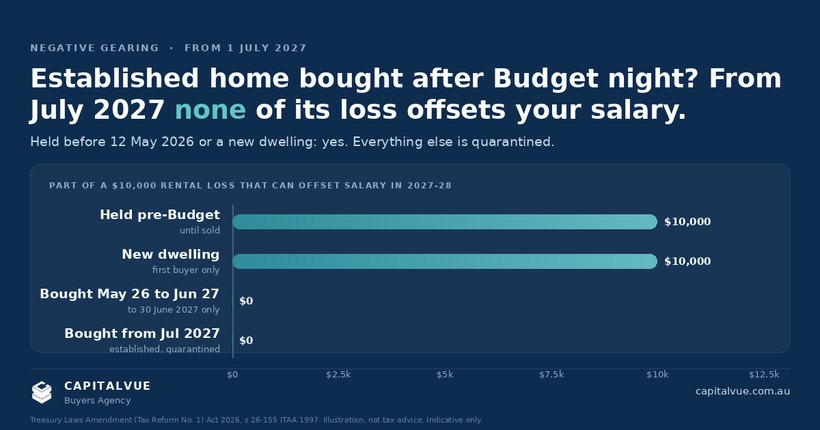
From 1 July 2027, a loss on an established residential property bought after Budget night can no longer reduce the tax on your salary. A loss on a property you already held can, until you sell it. Trusts and companies never passed a loss to anyone's salary, so for them the bigger changes are to capital gains tax and, if it passes, a minimum tax on discretionary trusts.
The change is law. The Treasury Laws Amendment (Tax Reform No. 1) Act 2026 received Royal Assent on 26 June 2026 and inserts a new section 26-155 into the Income Tax Assessment Act 1997. It applies from the 2027-28 income year. What follows is a description of how the law reads, not advice on what you should do with it.
| How and when you bought it | Can a rental loss reduce tax on your salary? |
|---|---|
| Established dwelling, contract signed before 7:30pm AEST on 12 May 2026 | Yes, for as long as you hold it. The concession ends when you sell |
| Established dwelling, contract signed after 7:30pm on 12 May 2026 and before 1 July 2027 | Yes, up to 30 June 2027 only. From 2027-28 the loss is quarantined |
| Established dwelling, bought from 1 July 2027 | No. The loss is quarantined from the start |
| New dwelling that adds to supply, such as a house on vacant land or a knock-down that replaces one dwelling with two | Yes. Later buyers of the same dwelling do not get it |
| Knock-down rebuild or substantial renovation that does not add a dwelling | No. It is treated as established |
| Commercial property | Not affected by this change. The measure applies to residential dwellings |
Sources: Treasury Laws Amendment (Tax Reform No. 1) Act 2026; Budget 2026-27 Tax Explainer, Negative Gearing and Capital Gains Tax Reform.
The date that matters is the contract date, not settlement. A contract signed before 7:30pm on Budget night that settled weeks later is on the grandfathered side of the line. There is no cap on the number of grandfathered properties one investor can hold.
Nothing about which expenses are deductible has changed. Interest, rates, insurance, property management, repairs and depreciation are all still deductions. What changes is where a loss can go once those deductions exceed the rent.
Under the old rules, that loss reduced your taxable income, salary included. Under section 26-155, the excess is not deductible in the year it arises. It becomes a quarantined amount that carries forward and can only be applied against net income from residential dwellings: rent from the same or another residential property, or the capital gain when you sell one. It is deferred, not lost. But it no longer comes back as a larger tax refund each year, and for many investors that annual refund helped make a negatively geared property affordable to hold on a salary.
The practical consequence is about cash, not tax. An investor buying an established property from July 2027 needs to be able to carry the full after-tax shortfall each month, with no refund at the end of the year to recover part of it. That can change how much a lender will be comfortable with, and how much buffer you may need, before anything else about the property is decided. The Buying Power Calculator is a starting point; a broker's assessment is the real number.
The exemption is for a "new residential dwelling", and the definition sits in the Treasury Laws Amendment (Tax Reform No. 3) Bill 2026, introduced on 14 October 2026 and not yet passed. Treasury consulted on the draft definition between 4 and 21 August 2026. The draft treats a dwelling as new where it adds to supply and the investor acquires it within 24 months of a certificate of occupancy being issued. The Budget explainer is clear on the principle: a dwelling built on vacant land, or a knock-down rebuild that increases the number of dwellings, qualifies. A substantial renovation, or a knock-down that replaces one house with one house, does not.
Two consequences follow. The first buyer of a qualifying new dwelling keeps negative gearing, including against salary. Every later buyer of that same dwelling does not, and does not get the old CGT discount either, which may narrow the pool of investors willing to pay a premium for it when you sell. That is a resale question worth asking before you buy new to keep a deduction.
One in three of the purchases we have made for clients has been bought in a trust. For those buyers, the negative gearing change matters less than the headlines suggest, because a trust has never passed a loss to its beneficiaries. A trust's rental loss always stayed in the trust and was carried forward against the trust's own future income. It never reduced anyone's salary.
What does change for trusts is three things. The quarantining rule applies inside the trust too, and it looks through interposed trusts and partnerships to income that comes from residential dwellings, so a trust's residential loss can now only be used against residential income. The 50% CGT discount is replaced for trusts, as it is for individuals, with indexation of the cost base and a 30% minimum tax on real gains accruing from 1 July 2027. And the government has proposed a 30% minimum tax on the taxable income of discretionary trusts from 1 July 2028.
That last measure is not law. The bills were tabled on 14 October 2026, and the ATO's own page describes the measure as "not yet law". Grant Thornton reported on 15 October that the Opposition is not expected to support the bills, so passage depends on the Greens in the Senate. If it passes in its current form, the trustee pays at least 30% on the trust's taxable income, unless a trust in existence at 1 July 2028 elects to make fixed distributions to pre-nominated beneficiaries. Individual beneficiaries get a non-refundable credit for that tax, and a company receiving a distribution gets none. The government has also announced a three-year rollover from 1 July 2027 to move assets out of a discretionary trust into another entity. A federal rollover covers income tax and CGT. It does not cover state stamp duty.
Companies are covered by the negative gearing change in the same way, so a company's residential loss is quarantined against its residential income. But like a trust, a company never passed a loss to anyone's salary in the first place, so in practice little changes there.
The bigger shift is relative. Companies never had the 50% CGT discount, so the CGT reform does not touch them, while individuals and trusts lose the discount on gains accruing from July 2027. Add the proposed minimum tax on discretionary trusts, and the gap between holding a property personally, in a trust or in a company narrows. Outside new dwellings and affordable housing, it is the first time since the discount was introduced in 1999 that individuals and trusts will not have it on newly accruing gains. That is one reason some investors are looking at companies again for residential property.
Narrower is not the same as better. Whether a company suits a particular buyer turns on things this change does not touch, and land tax is the clearest example of how much they differ by state. In Queensland, a company or trust pays land tax once its land is worth $350,000 or more, against $600,000 for an individual. In South Australia the 2026-27 general threshold is $936,000 and companies sit on the general scale, while most trusts are assessed from $25,000. The other factors are stamp duty; how money gets out of the company, including Division 7A; and what happens to the property when the shareholders' circumstances change. Commentary on the Act notes that a gain on selling shares in a company or units in a trust that holds a dwelling is not a residential capital gain, so quarantined amounts cannot be used against it. We will cover the company and trust comparison in a separate piece.
Complying super funds, including SMSFs, are outside the quarantining rule. But the same Act stops super funds, including SMSFs, from using new limited recourse borrowing arrangements, entered from 10 August 2026, to buy real property other than business real property. Existing arrangements are not affected. A fund buying with cash is unaffected by either change.
Treasury's draft second tranche proposes that a main residence first used to produce income after the start date keeps the existing negative gearing treatment, so a home you move out of and rent would not be quarantined. It is proposed, not law, and the detail may change before it passes.
Three questions come up on calls and are not answered by anything published so far. Whether refinancing or redrawing against a grandfathered property affects its status: nothing we have found says it does, and nothing says it does not. How the rules treat interest on money borrowed against one property and used for another investment: the long-standing rule is that deductibility follows what the money is used for, not what secures it, but how that interacts with section 26-155 and any integrity provisions in the second tranche is a question for a registered tax agent. And what the definition of a new dwelling will be once the No. 3 Bill passes. We will update this page with the date when any of them is settled.
If you already hold investment property, the line is drawn. Your grandfathered properties keep their treatment until you sell, which makes the decision to sell one a tax decision as well as a market one.
If you are buying an established property from here, plan on carrying the holding cost without a refund, and get the structure conversation done with your accountant before the contract, not after. Changing the name on a title later usually means paying stamp duty again. Choosing the structure at the start does not.
If you want the purchase side run against the evidence once the structure is settled, that is what our services are for. If you are earlier than that, the Property Readiness Snapshot takes a few minutes. Our earlier overview of ownership structures predates the Budget and is being updated.
General information only, not tax advice, financial product advice, credit assistance or legal advice. CapitalVue is not a registered tax agent. The law described here applies differently depending on your circumstances; obtain advice from a registered tax agent before acting on any of it. Statements about proposed measures describe bills and draft legislation that may change or may not pass. Current as at 17 November 2026. Sources: Treasury Laws Amendment (Tax Reform No. 1) Act 2026 (Act No. 49 of 2026, Royal Assent 26 June 2026), including section 26-155 of the Income Tax Assessment Act 1997; Commonwealth of Australia, Budget 2026-27 Tax Explainer, Negative Gearing and Capital Gains Tax Reform; Australian Taxation Office, Reforming negative gearing and capital gains tax, last updated 29 June 2026; Australian Taxation Office, Introducing a minimum tax on discretionary trusts, last updated 3 November 2026; Treasury, Capital Gains Tax and Negative Gearing, Tranche 2 exposure drafts, consultation 4 to 21 August 2026; Treasury Laws Amendment (Tax Reform No. 3) Bill 2026, introduced 14 October 2026; King and Wood Mallesons, Gearing up for a new era of negative gearing, 18 September 2026; Grant Thornton, Minimum 30 per cent tax on discretionary trusts, 15 October 2026; Holding Redlich, Federal Budget 2026-27: three tax changes reshaping investment, trust structures and business planning; Queensland Revenue Office, Land tax rates for companies and trusts; RevenueSA, Land tax rates and thresholds 2026-27. CapitalVue purchase records, as at November 2026, for the share of client purchases made in a trust. CapitalVue is a licensed buyers agency operating in South East Queensland and Adelaide, licensed QLD 4769773 and SA 335016.
Tell us where you are at and we will tell you what we would look at next. You will hang up with a plan, not more questions.