
What a buyers agent costs in Australia, how each fee model changes the agent's incentives, and what the ATO does with the money.
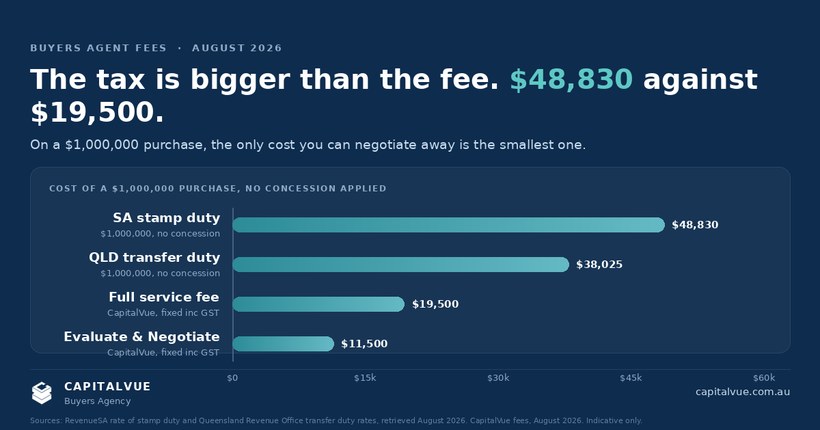
Buy a $1,000,000 house in Adelaide and the South Australian government takes $48,830 in stamp duty before you have replaced a single tap. That is two and a half times what a full buyers agent service costs. The same purchase in Brisbane attracts $38,025 in transfer duty.
A million dollars is not an extreme example any more. Cotality's July 2026 Home Value Index puts the Adelaide median house value at $1,007,684 and Brisbane's at $1,207,039. In both of our markets, a seven-figure house is the middle of the market rather than the top of it.
Nobody rings a buyers agent to complain about stamp duty, because stamp duty is not optional. The agent's fee is. So the comparison above is not an argument that our fee is good value, and you should be suspicious of anyone who presents it as one. It is only useful for what it tells you about attention: the largest avoidable cost in the transaction is not the fee, it is buying the wrong asset, and almost nobody scrutinises that with the energy they bring to an invoice.
The three questions worth asking are what structure the fee takes, what that structure does to the agent's incentives, and what happens to the money at tax time. All three are knowable before you sign anything.
Almost every buyers agency in Australia charges one of three ways.
| Model | How it works | What the structure rewards |
|---|---|---|
| Fixed fee | One number, agreed before the search starts, unchanged by what you buy | Finding the right asset, at any price point |
| Percentage of purchase price | A percentage of the price paid, commonly with GST added on top | A higher purchase price |
| Engagement plus success fee | A smaller upfront retainer, then a larger payment on an unconditional contract | Getting to a contract |
Check which of the three you are being quoted, and whether the number includes GST. Those two facts decide what you actually pay, and neither is always volunteered.
The percentage model carries a conflict, and it is worth being precise about where it actually sits.
The version usually quoted is the negotiation one: an agent on 2 per cent who negotiates $40,000 off the price has cut their own invoice by $800. True, and close to irrelevant. Nobody trades a $40,000 result for $800.
The real one is selection. On 2 per cent, guiding a buyer toward a $1,300,000 property rather than a $1,000,000 one is worth $6,000 to the agent. That is a meaningful sum, it arrives through a decision the buyer cannot audit, and it is dressed in language that always sounds like advice: better street, better long-term hold, stretch a little and buy once. None of that means percentage agents behave badly, and plenty negotiate ferociously against their own invoice. It means the structure asks something of them that a fixed fee does not.
The engagement-plus-success structure deserves the closest read of the three, and the question is simple. What happens if you never buy? If the search runs nine months and the market moves away from you, does the retainer cover that work, is it refunded, or does it simply disappear? Get the answer in writing before the search starts, because that is the scenario where fee disputes actually happen.
A fixed fee is not automatically cheaper. It falls as a share of the price as the price rises, which means there is a crossover point, and below it a percentage quote will come in lower.
Before you compare anything, ask one question: is that percentage plus GST?
It is the single most common reason two quotes that look close are not. A percentage may be quoted on the purchase price with GST added at invoice. Our fee is one number with GST already in it. Comparing a GST-exclusive percentage against a GST-inclusive fixed fee understates the percentage by a tenth, and a tenth is the whole margin in most of these comparisons.
Here is our $19,500 against three common rates, grossed up so every number in the table is what actually leaves your account.
| Purchase price | CapitalVue, inc GST | As a % | 1.5% + GST | 2.0% + GST | 2.5% + GST |
|---|---|---|---|---|---|
| $800,000 | $19,500 | 2.44% | $13,200 | $17,600 | $22,000 |
| $1,000,000 | $19,500 | 1.95% | $16,500 | $22,000 | $27,500 |
| $1,300,000 | $19,500 | 1.50% | $21,450 | $28,600 | $35,750 |
Read it honestly, in both directions.
At $800,000 a 1.5 or 2 per cent agent costs you less than we do, and you should know that before you call us. Against a 2 per cent quote our fixed fee only becomes the cheaper option above roughly $886,000. Against 1.5 per cent, not until about $1,182,000.
Above those points the gap runs the other way and it widens fast. At $1,300,000 our fee is lower than all three rates, including 1.5 per cent, and $9,100 below a 2 per cent quote for identical work.
We charge a flat fee anyway, and the reason sits underneath the arithmetic rather than in it. The work does not scale with the price. A $1,300,000 purchase does not take a third more research, inspections or negotiation than a $1,000,000 one, so we do not charge a third more for it, and we are never paid more for putting you in a dearer house.
If you are buying below the medians quoted at the top of this article, get a percentage quote as well and compare the two on a GST-inclusive basis. That is the arithmetic working properly, not against us.
In Queensland, a buyers agent cannot lawfully act for you without a written appointment. The Office of Fair Trading requires a Residential agent appointment or reappointment, the Form 6, or the commercial equivalent Form 6A. That form must set out the services the agent will provide and any limits on them, all commissions, fees and expenses, and when they fall due. If a number is not on the form, it is not agreed.
The appointment also governs the exit. Check the term and the notice provisions before you check the fee, because signing with a second agent while a first appointment is still running can leave you liable to both.
Licensing sits underneath all of it. Queensland agents, including buyers agents, must hold a licence under the Property Occupations Act 2014, and the register is public. In South Australia, a person or company carrying on a business that buys, sells or negotiates the buying or selling of land must be registered as a land agent through Consumer and Business Services, and that register is public too. Checking both takes about four minutes and it is the cheapest due diligence available to you.
One clarification, because these two get mixed up constantly in Queensland. Agent licensing and agent appointment sit under the Property Occupations Act 2014. The seller disclosure regime governing what a vendor must tell you about the property is a different statute, the Property Law Act 2023. Your agent's obligations to you and the seller's obligations to you are separate questions with separate answers.
Ask who else is paying the agent.
The Form 6 requires disclosure of all commissions, fees and expenses, which means a properly completed appointment shows any payment flowing to the agent from a source other than you. A marketing commission from a developer, a referral fee from a broker, a rebate from a project seller: each one changes what is likely to be put in front of you, regardless of the headline fee.
A low fee funded by someone else is not a low fee. It is a fee paid by the party whose interests are opposite to yours. CapitalVue takes no commission from sellers, on any transaction, ever.
This is the part most buyers get wrong, and the answer differs sharply depending on why you are buying.
For an investment property, a buyers agent fee is not an immediate deduction. The ATO treats remuneration for the services of an agent or consultant as an incidental cost under the second element of the cost base. It sits in the cost base alongside stamp duty and conveyancing, and it reduces your capital gain when you eventually sell. The benefit is real, but it is deferred, potentially by decades.
For an owner-occupied home, there is no capital gains event to shelter if the main residence exemption applies, so the fee is simply a cost. Buyers occasionally hear that buyers agent fees are tax deductible and budget accordingly. They are not deductible, and for an owner-occupier they are not recoverable at all.
On GST, the ATO position is that where you are not registered for GST, the GST component is included in the cost base rather than stripped out. Most individual investors are not registered, which is why a fee quoted inclusive of GST is the honest way to quote it.
None of this is tax advice and your circumstances will change the answer. Take it to your accountant with the contract in hand.
| Service | Fee (inc GST) | What it covers |
|---|---|---|
| Full Buyers Agent Service | $19,500 | Strategy, search, inspections, due diligence, negotiation or auction bidding, settlement management, property manager appointment |
| Evaluate and Negotiate | $11,500 | You find and inspect the property. We handle due diligence, the selling agent, negotiation or bidding, contract review and settlement |
| Auction Bidding | $2,200 per auction | Representation at auction only |
Fixed, inclusive of GST, quoted before the search starts, and published here rather than held back for a discovery call. There is no plus-GST line on our invoice and no success fee on top. What is in that table is what you pay.
We buy in Adelaide and South East Queensland only, which is the other half of the answer on fees. An agency that will buy anywhere is either carrying enormous research overhead or is not doing the research, and the fee has to reflect one or the other.
Evaluate and Negotiate exists because roughly three in ten of our clients have already found the house. They do not need a search. They need someone to work out whether the building and pest report contains a real problem, whether the disclosure holds up, and what the property is actually worth before they bid. Narrower job, narrower price. It is available to investors and owner-occupiers alike.
Licensed: QLD 4769773, SA 335016.
Treat the fee as a hurdle rather than a cost. On $19,500, the agent has to produce $19,500 of value for you to break even, and that value comes from one of three places.
The easiest to test and the weakest of the three. A 2 per cent improvement on a $1,000,000 purchase is $20,000, which clears the hurdle on its own, but you will never know the counterfactual price you would have paid yourself.
Larger and slower. The difference between a property that grows at 4 per cent and one that grows at 6 per cent compounds into six figures over a decade and dwarfs the fee entirely. It is also the hardest thing to verify at the point of sale, which is exactly why fee conversations rarely centre on it.
The one we see most often and the one buyers value least until it happens to them. A structural defect missed, a flood overlay not checked, a disclosure statement taken at face value. The saving is invisible because the loss never occurs.
If an agency cannot tell you which of those three they are being paid for, the fee is the wrong thing to be negotiating.
If you are weighing a full search against a targeted second opinion on a property you have already found, the inclusions for both are set out on our services and pricing page.
If you want to know what you can borrow and what that means for a budget in these markets, the buying power calculator gives you an indicative figure in about a minute.
For market-specific detail, including every purchase we have made for clients with prices paid and current values, see our Adelaide buyers agent and Brisbane buyers agent pages.
Or book a discovery call. We will tell you which service fits, and we will tell you when neither does.
General information only, not financial product advice, credit assistance, or a recommendation to buy any particular property. Figures are indicative and current as at August 2026. Sources: RevenueSA, Rate of stamp duty, page last updated 11 November 2024, retrieved 17 August 2026; Queensland Revenue Office, Transfer duty rates, retrieved 17 August 2026; Cotality Home Value Index, July 2026 release; Queensland Office of Fair Trading, Appointing a real estate buyer's agent; SA.GOV.AU, Land agent registration, Consumer and Business Services; Australian Taxation Office, Cost base of assets, QC 66022. Stamp duty and transfer duty figures assume a standard residential purchase with no concession or exemption applied and no foreign acquirer surcharge. Percentage fee comparisons are arithmetic illustrations at nominated rates, grossed up by 10 per cent GST, and are not quotes from or claims about any particular agency. CapitalVue fees are current as at August 2026 and inclusive of GST. Past performance is not a reliable indicator of future performance. Property values can fall. Consider your own circumstances and obtain independent financial, credit, legal and tax advice before making a property decision.
Book a free strategy call. We'll pressure-test your goals, show you what's possible, and tell you honestly whether we can help.