
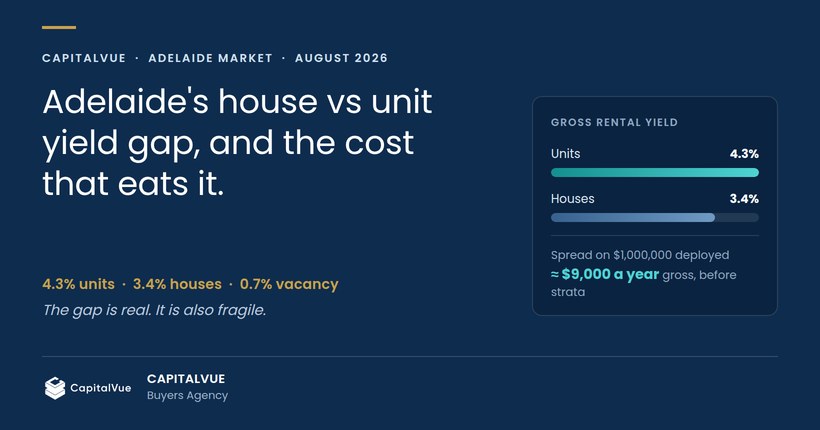
For investors weighing houses against units in Adelaide, at a point in the cycle where the gap between them is the widest it has been in years.
Adelaide units are currently returning around 4.3% gross against roughly 3.4% for houses. That 0.9 percentage point spread is wide by historical standards, and on a million dollars of capital it is worth about $9,000 a year in extra gross rent.
Most commentary stops there and concludes units are the better buy. That conclusion is wrong more often than it is right, and the reason is a cost that never appears in a yield figure.
| Measure | Houses | Units |
|---|---|---|
| Median value | $1,007,684 | $692,861 |
| Gross rental yield | 3.4% | 4.3% |
| Growth, year to July 2026 | +10.3% | +11.5% |
| Gross rent at the median | ~$659/week | ~$573/week |
Source: Cotality (formerly CoreLogic) Home Value Index, July 2026 release. Adelaide's overall dwelling value eased 0.2% during July, the second consecutive monthly fall, so both figures sit against a market that has stopped rising rather than one still running.
Note the third row, because it complicates the standard argument. Over the past year Adelaide units outgrew houses by 1.2 percentage points. The usual line is that houses carry the land component and therefore the growth, while units deliver income. Over this particular cycle, units delivered both.
Here is the arithmetic that matters. Deploy $1,000,000 in Adelaide today and you buy either roughly one house at the median, or roughly 1.44 units at the median.
Then the strata bill arrives. Typical annual contributions on an Adelaide two-bedroom sit somewhere between $1,400 and $10,000 depending entirely on the building. Apply that across 1.44 units:
| Building type | Strata cost on 1.44 units | Net income advantage vs a house |
|---|---|---|
| Small complex, under 20 lots, no lift or pool | $2,000 to $5,200 | +$3,800 to +$7,000 |
| Mid-size, 20 to 50 lots, lift or pool | $3,500 to $8,100 | +$900 to +$5,500 |
| Large or mixed-use, 50-plus lots | $5,800 to $14,400 | −$5,400 to +$3,200 |
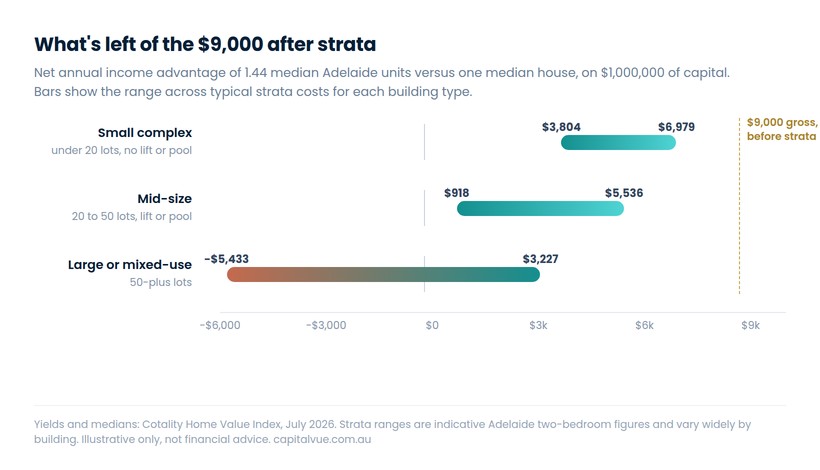
Read the bottom row again. In a large amenity-heavy building, the unit strategy can produce less net income than the house it was supposed to beat, on identical capital. The 0.9 point yield advantage does not survive contact with a pool, a lift and a 60-lot sinking fund.
This is not an argument against units. It is an argument that in Adelaide right now, the building matters more than the asset class. The same suburb, the same price, the same headline yield, and two buildings that produce materially different outcomes.
Three things, in our reading of the current data.
The median Adelaide house is now above $1m. Adelaide spent the last cycle as the affordable capital and that gap has largely closed, which caps what buyers can pay while rents keep responding to demand. Yields compress from the price side, not the rent side.
Adelaide's vacancy rate sits near 0.7%, the tightest of the mainland capitals, with asking rents averaging around $644 a week. In a market that tight, the cheaper the entry price, the higher the yield, almost mechanically.
The RBA cash rate is 4.35%, held in June 2026 after three increases in the first half of the year. Higher rates compress what buyers can borrow, and that pressure lands hardest on the most expensive stock. Units become the accessible option, which supports both their price growth and their rental demand.
Neither answer is right in the abstract. What we work through with clients comes down to five things.
Our South Australian mandate starts at $700,000, and this is part of the reasoning. In a market where values have stopped rising, the cheapest stock is where build quality, tenant profile and resale depth get tested hardest, and where a headline yield is most likely to be a mirage once the strata schedule is read properly.
Above $700,000 we can be selective about the things that decide a fifteen-year hold: the land component, the building's financial position, the street, and whether there is genuine owner-occupier demand sitting under the asset. We read the Form 1 vendor statement in full for exactly this reason, because the detail buried in it routinely changes what a property is worth.
If you want to see how that plays out in practice, our Adelaide buyers agent page publishes every South Australian purchase we have made for clients, including the ones below our current minimum, with prices paid and what they are worth now. If you would rather start with your own numbers, the buying power calculator gives you an indicative borrowing and budget figure in about a minute.
The Adelaide yield gap is real and it is unusually wide. It is also fragile. On $1,000,000 it is worth roughly $9,000 a year gross, and a single line item you cannot see in the listing decides whether you keep most of that, a fraction of it, or none of it.
That is a building-selection problem, not an asset-class decision. Anyone telling you units are simply the better Adelaide buy right now has not read a strata schedule.
General information only, not financial product advice, credit assistance, or a recommendation to buy any particular property. Figures are indicative and current as at August 2026. Sources: Cotality (formerly CoreLogic) Home Value Index July 2026 release; SQM Research vacancy rates and asking rents, June 2026; Reserve Bank of Australia cash rate target. Strata cost ranges are indicative Adelaide two-bedroom figures and vary widely by building. Past performance is not a reliable indicator of future performance. Property values can fall. Consider your own circumstances and obtain independent financial, credit, legal and tax advice before making a property decision.
Book a free strategy call. We'll pressure-test your goals, show you what's possible, and tell you honestly whether we can help.